
Gill Capital Partners August 2026 Market Update
The “dog days of summer” are waning, with families wrapping up their vacations and preparing for the upcoming school year. The financial markets did not get much rest or relaxation this summer, however, as they have faced geopolitical developments and a near-constant flow of economic data, some of which has created a rather consuming cross-current of data points. We will decipher what is important, and of course, provide our independent view on it.
U.S. Treasury rates just hit their highest level in about 25 years as a new Federal Reserve Chairman took the reins.
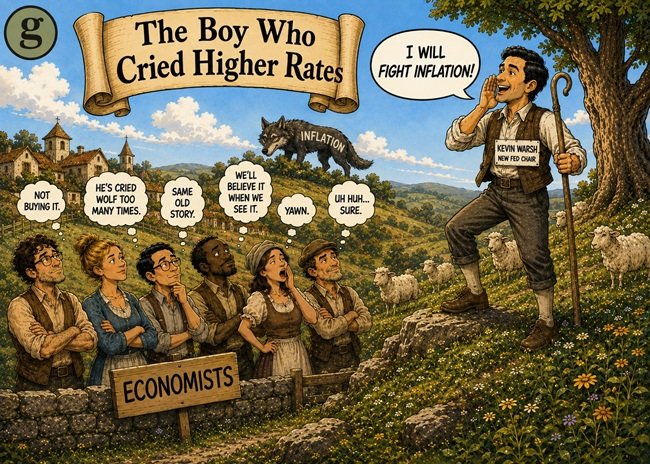
This month’s cartoon pokes fun at the new Federal Reserve chair, comparing him to The Boy Who Cried Wolf, one of Aesop’s most famous fables. Kevin Warsh’s recent communications and actions (or lack thereof) have many economists and long-time Federal Reserve experts confused. In the meantime, the bond market is doing the Fed’s job for them, as interest rates have shifted higher, with long-dated bonds like the 30-Year U.S. Treasury reaching their highest levels in approximately 25 years. The chart below shows the yield on the 30-Year U.S. Treasury going all the way back to the mid-1970s.
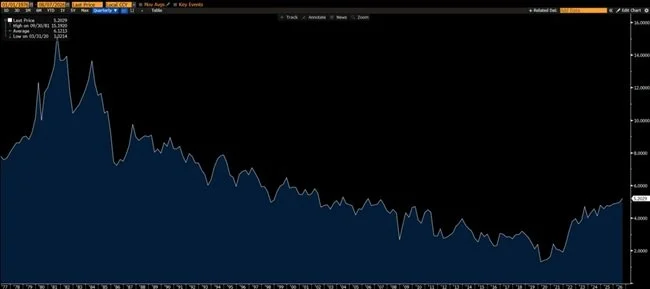
Over the last 40 years, the economy grew accustomed to consistently lower interest rates, with all-time lows reached during COVID. The economy is reacclimating to a more normal interest-rate environment. More on this below.
Update on Economic Fundamentals
Turning to the economy, updated economic reports have been released. Below are recent data points on jobs, wages, and inflation, along with our views on these fundamentals. As a reminder, we focus on fundamentals over headlines, so let's have a look.
Jobs – Below is a summary of the latest data on the U.S. labor market. As always, we like to look at several sources to provide a comprehensive picture of what is happening and what this may mean for the consumer, including reports from ADP, Challenger, Gray & Christmas, and the monthly Bureau of Labor Statistics (BLS) jobs report (which covers broad employment data, including government employment).
The (BLS) recently released the July jobs report. Total non-farm payroll employment unexpectedly declined for the month, falling by 23,000 jobs, and the unemployment rate fell to 4.1%. This was worse than consensus estimates that were calling for job gains of 83,000 for the month.
The ADP National Employment Report is a monthly look at private sector employment. In their most recent report, employers reported adding 44,000 jobs in July. This number was weaker than consensus estimates, which expected job growth to be 70,000 to 75,000 for the month.
The Layoff Tracker is a monthly report by Challenger, Gray & Christmas, an executive outplacement and career transition firm that compiles the number of job cuts announced by U.S.-based employers and has been published monthly since the 1990s. The most recent data shows that U.S.-based employers announced 33,429 job cuts in July, down 27% from June, marking the lowest monthly level of layoffs announced in two years. This brings the year-to-date total to 477,000.
Our view
July was bit confusing with contradictory reports. The long-term trend, however, continues to point to a labor market that is slowing but not deteriorating sharply. The three reports taken together suggest that employers are becoming more selective in hiring rather than broadly reducing their workforces. The labor market appears to be transitioning from the exceptionally tight conditions of the past several years toward a more balanced environment. Furthermore, while the pace of hiring has slowed, the relatively low level of announced layoffs and historically low unemployment rate suggest that the broader economy continues to expand, albeit at a more moderate pace. This is likely consistent with an economy that is cooling rather than contracting and one that remains resilient despite ongoing policy uncertainty.
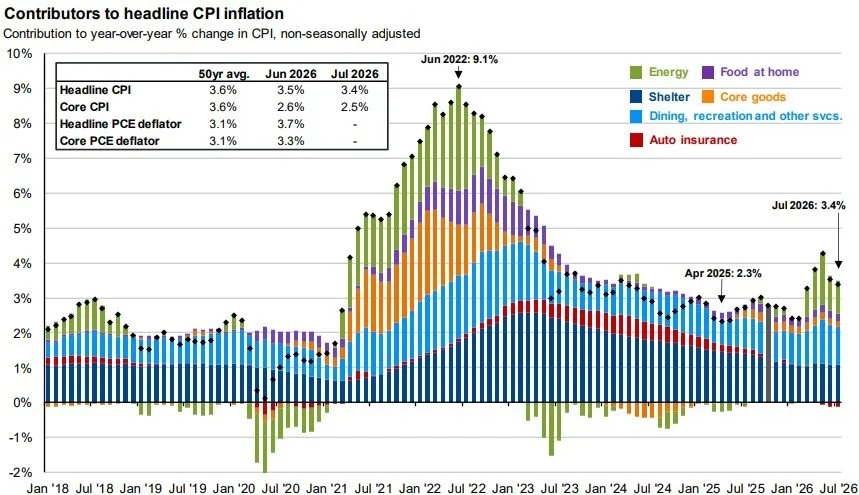
Inflation, Interest Rates & The Federal Reserve – The most recent Consumer Price Index (CPI) report, released by the Bureau of Labor Statistics, shows that prices rose again in July. Headline CPI increased 0.1% month-over-month (seasonally adjusted) in June, and rose 3.4% on a year-over-year basis, well above the Federal Reserve’s 2.0% target. Core CPI, which excludes volatile food and energy prices, was flat for the month and rose 2.5% over the past 12 months.
These numbers were generally in line with revised expectations that accounted for the impacts of the ongoing war in Iran and the associated volatility in energy prices.
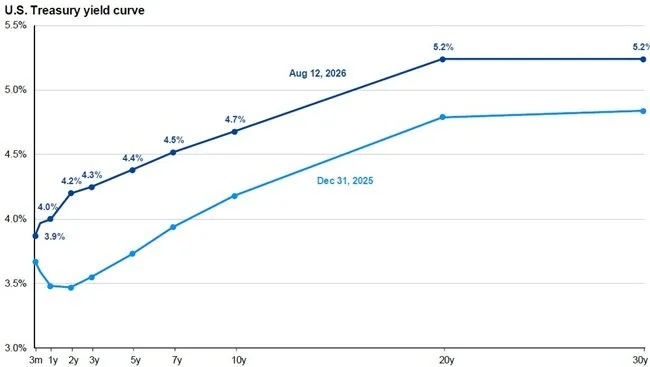
Interest rates have meaningfully shifted higher as of late as inflationary pressures have persisted. As shown in the chart below, the most pronounced move has occurred on the short end of the yield curve, where rates have risen by almost a full point since the end of last year. This is a result of drastically changing expectations of the future direction of interest rates. Eight months ago, the market expected the Federal Reserve to cut interest rates multiple times in 2026. Now the expectation is for 1-2 increases before the end of 2026.
The Federal Reserve now has two meetings under its belt with newly appointed Chairman Kevin Warsh. Each Federal Reserve Chairman has a slightly different style and manner of communicating. At the last meeting, the Federal Reserve left interest rates unchanged, maintaining its wait-and-see approach, while communicating its focus on returning inflation to its 2% mandate. The decision was not unanimous, with three governors dissenting in favor of raising interest rates, suggesting that the Fed is more seriously considering such a move.
Our view – This is an extremely curious interest-rate environment, with the Fed in a tough spot. Their wait-and-see approach may prove to be the correct one. However, the bond market is growing tired of the Fed’s inaction and is taking matters into its own hands, so to speak, tightening financial conditions for the Fed with higher interest rates. The problem that the Federal Reserve faces is that the primary source of inflation is a supply-induced oil shock due to the ongoing war in the Middle East, and higher interest rates will do little to fix it. Fixed-income buyers are being treated to some of the best interest rates in the past 30 years, with taxable interest rates on high-quality fixed-income securities now competing with equity returns.
Corporate Earnings and the Stock Market – Corporate earnings continue to improve as we move through the second quarter reporting season. We are seeing an extremely strong quarter for corporate earnings. With the majority of companies having already reported, approximately 85% have exceeded analyst estimates. As shown in the chart below, earnings growth for the S&P 500 is currently tracking at approximately 30% year-over-year, while revenue growth is running near 13%, marking one of the strongest quarters for corporate profit growth since 2001.
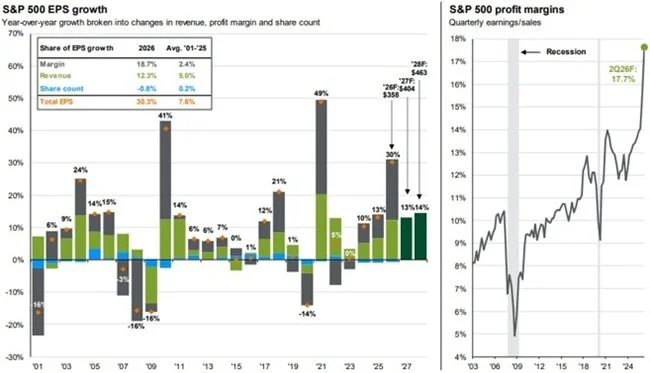
Our view – The stock market has rebounded recently on the back of a strong earnings season, which has reassured investors amid rising interest rates and oil prices. Portfolio diversification has worked this year. While many are focused on AI and technology investing, the best returns this year have come from less-talked-about asset classes, such as international, small-cap, and value stocks, which have far outpaced the S&P 500.
Give Back with Gill Capital Partners

Join the Gill Capital Partners team on Friday, September 11, as we Give Back with Food for Thought, an organization helping provide weekend meals to children and families in need throughout the Denver metro area.
We'll gather at 7:00 a.m. at 1600 W. Colfax Ave. to sort and pack PowerSacks alongside fellow volunteers, followed by breakfast together at a nearby restaurant.
We'd love to have you join us for this meaningful morning of giving back! If you would like to attend, please RSVP to Sammi Moczo at smoczo@gillinvest.com.
As always, please let us know if you have any questions or concerns, or if we can provide assistance with any other financial planning matters, including education, taxes, insurance, or estate needs.