
Gill Capital Partners September 2026 Market Update
September brings fall colors, cooler temperatures, a return to football, and now, higher interest rates. There has been a lot going on during the month of September in the world of economics and financial markets, and we will do our best to break it all down. We also have a “Financial Planning Corner” included at the end of this month’s commentary, which discusses Health Savings Accounts (HSAs) and how to best utilize them. Let's jump right in.
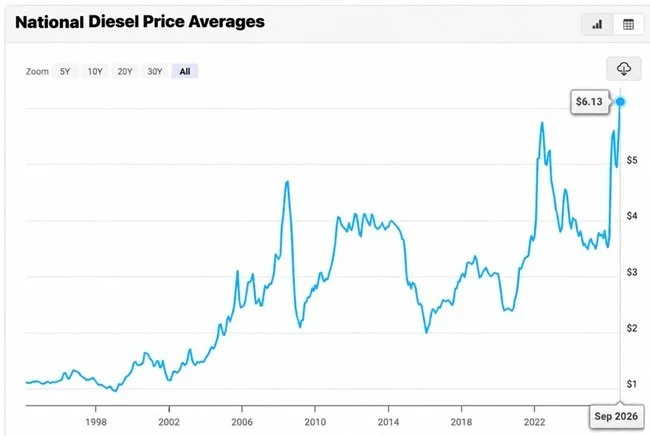
As crude oil inventories have declined due to the ongoing war in Iran, prices for its top derivatives are skyrocketing. Diesel prices, as shown in the chart below, are at an all-time high. Why is the price of diesel fuel so important? Ground freight is by far the dominant mode of transportation for goods in the U.S., with approximately 65% of all goods transported by truck. Furthermore, truck freight accounts for 56% of the world's diesel demand. A typical 18-wheeler carries approximately 200 gallons of diesel fuel. Filling it now costs $1,250, about a $120 increase in only 3 weeks.
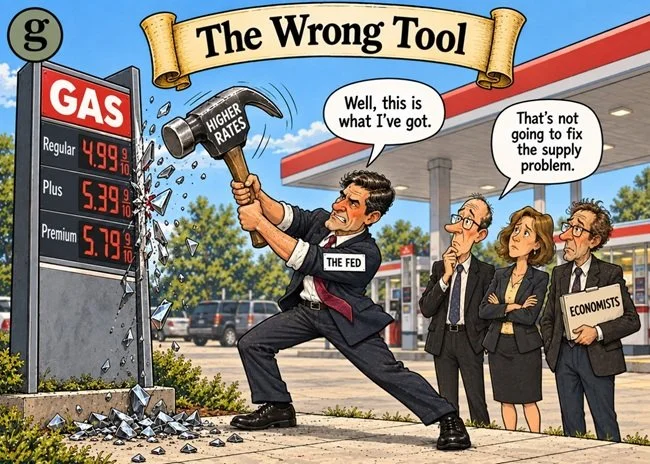
Not to state the obvious, but as long as oil prices remain elevated and supplies remain tight, inflation will remain a problem. Our cartoon this month makes light of the Federal Reserve not having the right tools for this particular problem, since higher interest rates aren’t likely to solve an oil price spike. More on this below.
Update on Economic Fundamentals
As we do every month, we would like to provide a brief review of economic fundamentals. Below are recent data points on jobs, wages, and inflation, along with our views on these fundamentals. As a reminder, we focus on fundamentals over headlines.
Jobs – Below is a summary of the latest data on the U.S. labor market. As always, we look at several sources to provide a comprehensive picture of what is happening and what this may mean for the consumer, including reports from ADP, Challenger, Gray & Christmas, and the monthly Bureau of Labor Statistics (BLS) jobs report (which covers broad employment data, including government employment).
The BLS recently released the August jobs report. Total non-farm payrolls increased by 162,000 jobs, and the unemployment rate remained unchanged at 4.1%. This was quite a bit stronger than expectations, which called for roughly 50,000 new jobs for the month. This brings the 12-month average job gains to 31,000 per month, well below the historical average.
The ADP National Employment Report is a monthly look at private sector employment. In their most recent report, employers reported adding 38,000 jobs in August. This number was weaker than consensus estimates, which expected job growth of around 45,000 for the month. This brings the 12-month average to 49,000 per month, also well below its long-term average.
The Layoff Tracker is a monthly report by Challenger, Gray & Christmas, an executive outplacement and career transition firm that compiles the number of job cuts announced by U.S.-based employers and has been published monthly since the 1990s. The most recent data show that U.S.-based employers announced 52,429 job cuts in August. Year to date, employers have announced 529,914 job cuts, 41% fewer than the first eight months of 2025.
Our view
The labor market, while not overly strong at the moment, appears to have stabilized. We would characterize the current labor market as a low-hiring, low-layoff labor market that has weakened materially, but is not showing broad-based deterioration. It appears that companies are generally being more selective in their hiring, but we are not seeing broad-based layoffs. This remains consistent with an economy that is cooling rather than contracting, and businesses are seeing massive productivity gains through AI, which allows firms to grow without the same level of hiring.
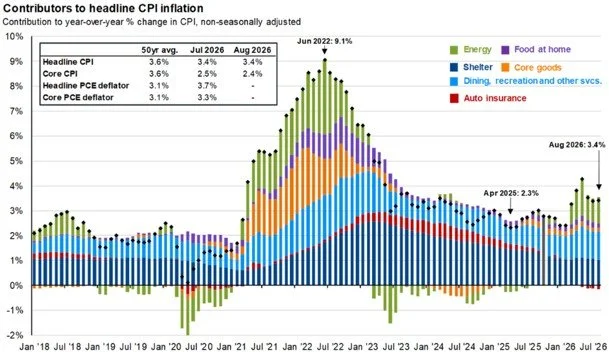
Inflation, Interest Rates & The Federal Reserve – The most recent Consumer Price Index (CPI) report, released by the Bureau of Labor Statistics, shows that prices rose again in August. Headline CPI increased 0.4% month-over-month (seasonally adjusted) in August, and rose 3.4% on a year-over-year basis, well above the Federal Reserve’s 2.0% target. Core CPI, which excludes volatile food and energy prices, also accelerated by 0.3% for the month and rose 2.4% over the past 12 months.
These numbers were generally in line with revised expectations that accounted for the impacts of the ongoing war in Iran and the associated volatility in energy prices. Unfortunately, as explained above, we have seen a further surge in energy prices since these inflation reports, driven by heightened tensions in the Middle East, which have led to additional supply disruptions. The market anticipates this will worsen in the near term.
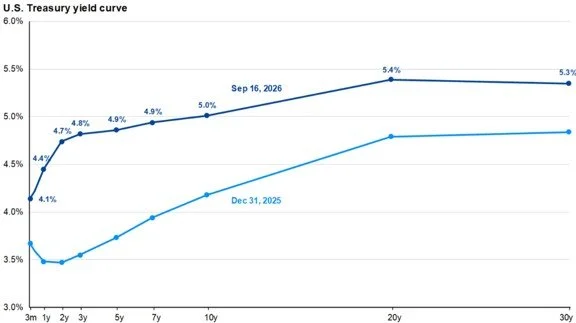
All eyes have been focused clearly on interest rate markets and the Federal Reserve as interest rates have moved meaningfully higher. The ongoing war in Iran has continued to disrupt oil markets, pushing inflation higher. Interest rates have risen significantly since the beginning of the year, when markets were anticipating a high probability of rate cuts. The war in Iran has completely changed that picture, and, as shown in the chart below, rates have risen materially since the beginning of the year with the interest rate curve shifting meaningfully higher in anticipation of Federal Reserve rate hikes, the first of which we saw this week.
The Federal Reserve raised its benchmark interest rate by 25 basis points to a target range of 3.75-4%, its first increase since 2023. The decision was unanimous. Updated projections and market expectations point to another rate increase this year. Following the most recent meeting, Federal Reserve Chair Kevin Warsh said, “Inflation has been too high for too long.” He also explained that recent economic reports showed the economy, including the labor market, was strong. Increased tensions in the Middle East also contributed to the decision.
Our view – This week's interest rate increase was widely anticipated and priced into markets. We joked above about the Federal Reserve trying to fight high gas prices with higher interest rates, which really are not an effective tool in this situation. However, if they had not raised interest rates, they would have lost credibility, and long-dated interest rates would have likely moved materially higher. While higher interest rates are not likely to fix this inflation issue anytime soon, there are a few positive takeaways from the current situation. First, the Federal Reserve has regained some of the credibility it lost after the last meeting, when Fed Chair Kevin Warsh confused markets with his messaging. Secondly, the vote was unanimous; all voting members supported a rate increase, including Stephen Miran, who has been publicly calling for lower rates. This is good news, as the Federal Reserve appears to be at least on the same page. Finally, from an investor's perspective, interest rates are the highest we have seen in 20 years or more, and we can now lock in extremely compelling yields on safe, high-quality fixed-income investments
Stock Market Updates – Global equity markets have seen increased volatility recently and are just off their all-time highs. The S&P 500 is currently 2.1% below its high on August 13th, the Dow Jones Industrial Average is 4.7% below its high on August 5th, and the Nasdaq Composite is 2.5% below its high on June 2nd. Equity markets have proven remarkably resilient as macro fears and the impacts of higher inflation and interest rates are being offset by impressive corporate profits and improving valuations.
Our view – The stock market has shown impressive resilience amid significant headwinds. One item we have been watching lately is the improvement in valuations. Even with markets near all-time highs, we have seen valuations become significantly more attractive. The chart below shows the “P/E Ratio” or Price to Earnings rate of the S&P 500. This is a simple math calculation: the stock price, “P” divided by earnings, “E.” While stock prices (the numerator) have generally moved higher this year, earnings (the denominator) have improved rapidly, thereby materially improving this common valuation metric.
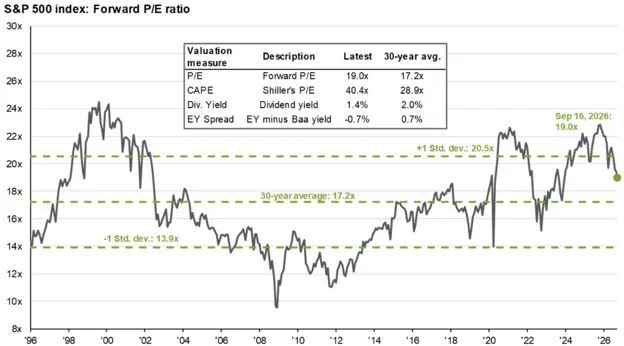
Profits have rebounded recently on the back of a strong earnings season, reassuring investors amid rising interest rates and oil prices. Portfolio diversification has worked this year. While many are focused on AI and technology investing, the best returns this year have come from less talked-about asset classes, such as international, small-cap, and value stocks, which have far outpaced the S&P 500.
Financial Planning Corner - HSA (Health Savings Accounts): Basic & Advanced Techniques
An HSA is a purpose-built tool to pay for healthcare expenses for both pre-retirees and retirees. HSAs were officially created on December 8th, 2003, with the Medicare Prescription Drug, Improvement, and Modernization Act signed into law by President George W. Bush and became available to US taxpayers on January 1st, 2004.
HSAs offer the unique benefit of being triple tax-advantaged:
A tax deduction on contributions made into this account
Tax-deferred growth
Tax and penalty-free withdrawals for any qualified healthcare expenses
The first requirement of a Health Savings Account is enrollment in a High Deductible Health Plan (HDHP). With the expansion of these accounts under the One Big Beautiful Bill Act (OBBA), all Bronze-level and Catastrophic-level plans within the Affordable Care Act marketplace automatically qualify as HDHPs. Either individuals or families can be covered by an HDHP, and the contribution limits adjust depending on who is covered. To be eligible to contribute to an HSA plan, you may not be covered by a traditional (low-deductible) health plan. This includes being covered on a spouse’s non-HDHP policy. Keep in mind that you should not contribute to an HSA within six months of signing up for Medicare due to a lookback period. Contribution limits vary by account type and are listed below:
Summary of 2026 limits:
Contribution Limit - Single: $4,400
Contribution Limit - Family: $8,750
Catch-up Amount (age 55+): $1,000
Qualified Healthcare Expenses:
What are qualified healthcare expenses? The definition is quite broad and includes the following:
Insurance Costs
(Deductibles, Copays, and Co-insurance)
Medicare Part B Premiums & IRMAA Medicare Surcharges
Long Term Care Policy Premiums (capped based upon age)
Doctor Services
Emergency Care
Prescriptions
Dental Care
Vision Care
Mental Health Care
Please note that there may be strict consequences for withdrawing funds from an HSA if they are not used for qualified healthcare expenses. For those under age 65, this includes paying ordinary income tax and a 20% penalty on the distribution. For those over age 65, there is no penalty, but the withdrawal is subject to ordinary income tax.
In essence, an HSA turns into a Traditional IRA after age 65. Some individuals refer to these types of accounts as a “Stealth IRA,” and one technique is to utilize an HSA as an additional retirement account for the future. However, paying for healthcare expenses in retirement is the true purpose and the most efficient use of these accounts.
One technique is to contribute the maximum to your HSA and invest in an aggressive allocation for future expenses while paying current healthcare costs out of pocket. This is one of the best options if your current cash flow allows. Contributing to an HSA allows the funds to grow for years before being used for qualified healthcare expenses in retirement.
An advanced funding technique is to contribute to your HSA through your payroll, as this will help you to maximize your savings on payroll taxes (Social Security & Medicare – FICA taxes). This can save an additional 7.65% in taxes for these contributions each year.
Another interesting feature is that there is currently no time limit for reimbursing oneself from an HSA for prior healthcare expenses (i.e. multiple years of expenses can be reimbursed all at once). Thus, you can save receipts from healthcare expenses over the years and reimburse yourself when you prefer to draw from the HSA. This can allow a distribution of tax and penalty-free funds whenever needed (subject to any future changes by Congress).
Please reach out to your advisor with any questions. We are happy to speak with you further about how to maximize your use of HSAs and help you plan for your future retirement healthcare costs.
As always, please let us know if you have any questions or concerns, or if we can provide assistance with any other financial planning matters, including education, taxes, insurance, or estate planning needs.