
Gill Capital Partners November 2026 Market Update
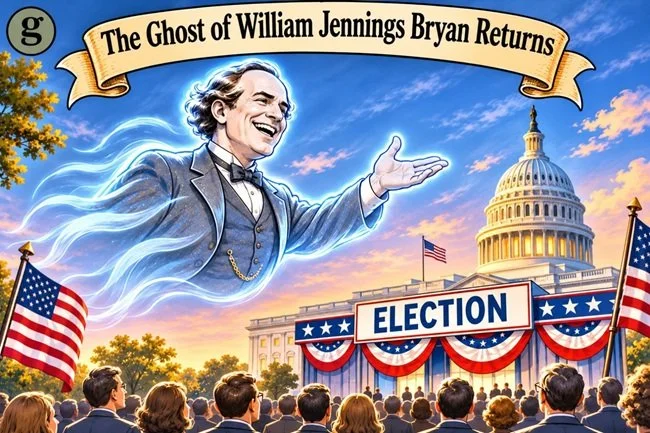
The mid-term elections are now behind us, and we hope you are enjoying the absence of political ads, texts, and calls as much as we are. It has been a busy few weeks between the mid-term elections, interest rate decisions, and volatile markets. We will get into all of that and more, but first, our cartoon this month is for the history buffs. It conjures the ghost of William Jennings Bryan, who led a populist charge in 1896, arguing that the economy favored big banks, monopolies, and big industry at the expense of farmers and working Americans. His populist movement in 1896 bridged party lines and proved to be an important turning point in American political history. We do not know whether this will prove to be an equally important turning point, but there appear to be some parallels to the political environment of the late 1800s. That said, let’s jump right in.
What does a Democratic Congress mean for Markets?
Democrats had a decisive win in last week’s midterm elections, marking the largest congressional margin of victory for either party since 1976, and will now look to impose significant restraints on the President for the remainder of his term. What does this mean? Gridlock is likely to rule for the next two years, with the first major test coming shortly as government funding is set to expire on December 11th. The economy, affordability, and inflation dominated the election, along with AI & data centers. The elections showed a growing opposition to data centers and a thirst for AI regulation across the political spectrum. AI remains an evolving public concern, and while future regulation may slow the AI buildout and make it more expensive, we believe the AI boom is likely to remain largely on track. The market's knee-jerk reaction this past week likely presents an opportunity for long-term investors to own great companies at much lower prices than just a few weeks ago.
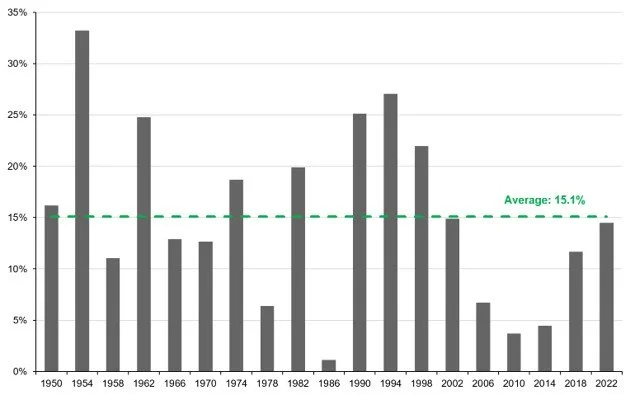
How have markets performed historically following midterm elections? As shown in the chart below, the S&P 500 has been higher 12 months after every midterm election since 1950, with an average gain of about 15% in the year following the election. Markets have traditionally looked favorably upon the restraint imposed by divided government. Further, valuations have come down meaningfully over the past few months and are now the lowest they’ve been on a price-to-earnings basis in three years, making equity markets more attractive from a pure valuation perspective. These data points certainly set the stage for potentially strong equity returns in the coming year.
1-year price return following midterm elections, 1950-2022
Update on Economic Fundamentals
As we do every month, we want to provide a brief review of economic fundamentals. Below are recent data points on jobs, wages, and inflation, along with our views on these fundamentals. As a reminder, we focus on fundamentals over headlines.
Jobs – Below is a summary of the latest data on the U.S. labor market. As always, we look at several sources to provide a comprehensive picture and what this may mean for the consumer, including reports from ADP, Challenger, Gray & Christmas, and the monthly Bureau of Labor Statistics (BLS) jobs report (which covers broad employment data, including government employment).
The BLS recently released the August jobs report. Total non-farm payrolls increased by 165,000 jobs, and the unemployment rate dropped to 4.1%. This was stronger than expectations, which called for roughly 59,000 new jobs for the month. In addition, both August and September reports were adjusted higher by an additional 84,000 jobs.
The ADP National Employment Report is a monthly look at private sector employment. In their most recent report, employers reported adding 86,000 jobs in October. This number was slightly stronger than consensus estimates, which expected job growth of around 75,000 for the month.
The Layoff Tracker is a monthly report by Challenger, Gray & Christmas, an executive outplacement and career transition firm that compiles the number of job cuts announced by U.S.-based employers and has been published monthly since the 1990s. The most recent data show that U.S.-based employers announced 43,994 job cuts in October. Year to date, employers have announced 617,189 job cuts, 44% fewer than the first ten months of 2025.
Our view
The labor market has perked up and is now showing moderate strength across the board. While this would not be considered a “tight” labor market, it is certainly transitioning to a “low-fire” environment that appears to have stabilized, and even strengthened, over the course of the year. While this is not a particularly strong labor market by historical standards, it does not have any recessionary red flags at the moment, either.
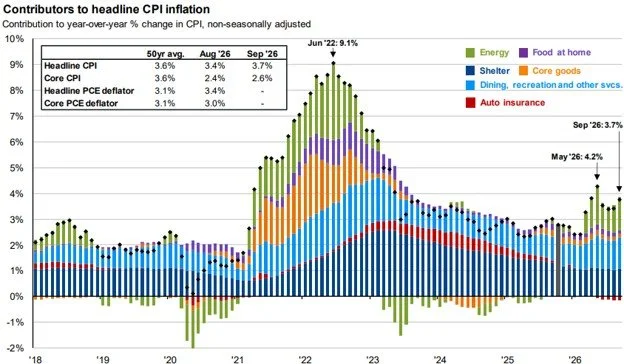
Inflation, Interest Rates & The Federal Reserve – We received a fresh read on inflation recently with the Consumer Price Index (CPI) report, released by the Bureau of Labor Statistics, showing that prices rose again in September. Headline CPI increased 0.6% month-over-month (seasonally adjusted) in September, and rose 3.7% on a year-over-year basis, well above the Federal Reserve’s 2.0% target. Core CPI, which excludes volatile food and energy prices, also accelerated by 0.3% for the month and has accelerated by 2.6% over the past 12 months.
These numbers were generally in line with revised expectations that accounted for the impacts of the ongoing war in Iran and the associated volatility in energy prices. Energy prices were the major factor again, with gasoline rising 9.1% and accounting for half of the index's increase. However, price pressures were broad-based, with gains in shelter, vehicle costs, and apparel. We are unlikely to see a near-term improvement in the inflation picture until the war in Iran reaches a reasonable conclusion and oil starts flowing again across the globe.
The Federal Reserve met two weeks ago and voted to keep interest rates on hold, opting to take a patient approach in their fight against inflation despite recent increases. Two of the twelve FOMC voters dissented, both of whom wanted the committee to raise rates by a quarter percentage point. Statements from the Federal Reserve over the past couple of weeks have reflected a desire to wait for additional data before further tightening. While rates are still up materially this year, interest rates have eased over the past few weeks as the Federal Reserve's more patient approach has calmed rate markets.
Our view – The Fed pause prior to the midterm election made sense. However, the market still expects higher rates. As of this writing, futures markets are pricing in a 90%+ probability that the Federal Reserve will raise interest rates by another ¼ point by the end of the year and an additional ¼ point sometime in 2027. This is still largely dependent on oil prices. While we are unsure whether we will see higher rates, we do not expect a return to low interest rates anytime soon. A strengthening labor market, combined with broad based economic strength, is providing for a resilient economy that does not currently warrant lower interest rates. Higher for longer should be the expectation for now.
We'll see you next month. In the meantime, enjoy the blissful quiet of a world without political ads and campaign texts!
As always, please let us know if you have any questions or concerns, or if we can provide assistance with any other financial planning matters, including education, taxes, insurance, or estate planning needs.