
Gill Capital Partners Thanksgiving 2026 Market Update
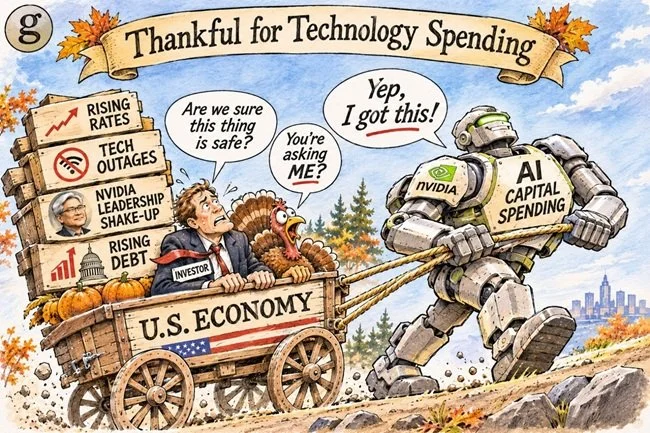
We generally try not to inundate your inbox, but there have been quite a few important headlines since our last communication, including multiple Nvidia updates and one of the most exceptional 2-day trading periods ever. We want to provide an overview of what is going on and, of course, share our thoughts on it all. We also wanted to send a note of gratitude and wish our clients, partners, and friends an enjoyable and peaceful Thanksgiving. The Gill Capital Partners team truly values our relationships with you and is honored to serve you.
Market Update
Where do we begin!? As of Friday afternoon, equity markets were officially in correction mode and the headlines were bleak. The Friday afternoon sell-off saw many indices give up most of their year-to-date gains, leaving the S&P 500 up roughly 3% for the year and the NASDAQ Composite Index slightly negative. The selling was driven by a confluence of factors, culminating in a cascade of panic selling into the close on Friday. More details on these factors below.
AI and Technology Repricing - Investors have increasingly questioned the returns on massive AI capital expenditures. Semiconductor and other technology stocks have been particularly weak.
Removal of Jensen Huang, the CEO of Nvidia – The recent resignation of Nvidia CEO Jensen Huang following multiple scandals created uncertainty about what is likely the most important stock in the AI world.
Interest Rate Concerns - A more hawkish Federal Reserve outlook has pressured equity valuations, particularly higher-multiple growth stocks, as numerous Federal Reserve officials have signaled higher rates to come.
Outages - A string of unexplained tech outages and related incidents like the FAA ground stop and the Microsoft Outlook outage have created a nervous backdrop.
Fast forward to Monday morning, just a few minutes before the market opened, headlines broke that the Nvidia board of directors rehired Jensen Huang as their CEO following a call with President Trump over the weekend. The President strongly recommended that Nvidia rehire the embattled CEO and assured them that the potential national security issues resulting from his relationship with a Chinese spy had been investigated and cleared by the DOJ. Nvidia stock immediately skyrocketed 30%+ following the news, and broad markets are significantly higher on the news.
Our view
This can only be described as one of the most extraordinary 2-day trading periods we have ever seen. The tone on Friday afternoon was extremely negative, with major concerns about the very foundation of the tech trade that has fueled the market for the past 3+ years. Nvidia has become central to so much of the financing, deal-making, and technology driving the AI boom and appeared to be in major trouble.
Almost as quickly as things seemed to fall apart of Friday, they’ve been patched back together today. With Jensen Huang now reinstated and news that the DOJ investigation will not uncover charges against the company or Mr. Huang, it appears that the worst-case scenario has likely been taken off the table for markets. This doesn’t mean that all concerns have been resolved and we will quickly return to all-time highs, but the downside risk to the market appears to be much less severe than it looked to be on Friday. The market is looking for clarity on several fronts, including Nvidia’s accounting practices, the direction of interest rates, technology outages, and the policy priorities of the new Democratic Congress, particularly how it will work with the Trump administration. While these uncertainties may contribute to near-term volatility, we believe they are more likely to be absorbed through a normal market correction rather than a more significant or prolonged downturn.
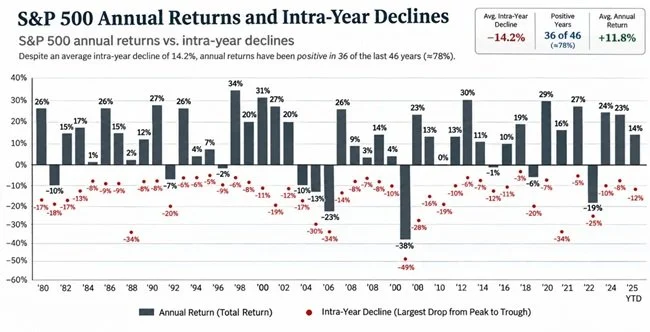
While market corrections can be unsettling, they are quite common; in fact, on average, we see a market correction of at least 10% approximately every 12-18 months. As shown below, the S&P 500's average intra-year decline since 1980 has been approximately 14%, yet the market has finished the year positive roughly 75% of the time. This serves as an important reminder that short-term market volatility is a natural part of investing and does not necessarily indicate a prolonged downturn.
We do not know if Friday was “the bottom,” but for now it appears that way. Here are some data points we follow that suggest Friday’s panic selling was at the very least a near-term bottom, if not a longer-term one.
Investor Fear Is Elevated: The VIX (Volatility Index), often referred to as Wall Street's "fear gauge," reached 39 on Friday afternoon. Historically, readings above 30 have often coincided with periods of heightened investor pessimism and attractive longer-term buying opportunities. Volatility can certainly rise further, but we are entering a range that has frequently been associated with market bottoms. Furthermore, the VIX has dropped materially as of this writing, telling us that fear is dissipating.
Technology Stocks Are Deeply Oversold: Many technology stocks have experienced substantial declines, bringing valuations down and pushing several technical indicators into deeply oversold territory. These conditions have historically increased the potential for a near-term rebound, particularly when selling has been as concentrated and aggressive as we've recently witnessed. We are seeing a sharp rebound today, but many of these companies remain deeply oversold.
Signs of Capitulation Are Emerging: This past week’s selling has taken on more of a "panic flush" feel, with investors appearing increasingly willing to sell regardless of price. While unsettling, this type of capitulation can be a constructive development. Market bottoms are often formed when selling pressure becomes exhausted and pessimism reaches an extreme.
Credit Markets Remain Relatively Stable: Despite the equity market selloff, high-yield (junk) bond spreads have widened only modestly. Importantly, we are not seeing the significant deterioration in credit markets that typically accompanies more severe economic or financial stress. This suggests that the current decline may be driven more by investor sentiment and valuation adjustments than by concerns about widespread financial instability.
Government Intervention – Many market bottoms have been put in with government intervention in different forms; the “recommended” rehire of Jensen Huang is just that and creates a backstop for the entire market.
Market bottoms rarely feel comfortable in real time. In fact, they often occur when investor sentiment is at its worst. Given the combination of elevated fear, oversold conditions, and emerging signs of capitulation, we believed the market was becoming increasingly positioned for a meaningful relief rally as of the close on Friday. However, there was a lack of clarity regarding Nvidia's future and the other items mentioned, which may have been short-term. Today’s headlines provide much-needed clarity for markets and for investors.
Such rebounds as we are seeing today can happen very quickly, which is why we caution investors against becoming overly optimistic or pessimistic in times like these. What should investors do now? Take a deep breath and trust your long-term plan. We tend to recommend against making big moves in times like this; we will be looking for opportunities to rebalance as needed, but for now investors should look at this as a fairly normal market correction with extraordinary headlines.
Inflation, Interest Rates & The Federal Reserve – The Federal Reserve is set to meet in approximately 3 weeks and is signaling more interest rate increases to come in the wake of recent reports showing inflationary pressures that have continued to accelerate. The minutes from the October FOMC meeting were released recently and showed that nearly all officials expect that higher rates will be needed to lower inflation, with two officials seeing the possibility of a half-point increase in December. This information pushed rates higher, putting more pressure on equities.
Our view – As we have echoed repeatedly, we do not believe higher rates are likely to solve the inflation problem, which is largely driven by the war in Iran and higher oil prices. Good news: since the election, we have seen a material drop in oil prices, with oil pushing into the low $ 80s, which will likely result in a corresponding drop in the monthly inflation numbers, assuming it holds. Furthermore, the Fed is unlikely to raise rates dramatically, or perhaps at all, given the current state of equity markets. This will further ease equity market concerns, and we are seeing rates drop in anticipation of this.
We'll see you next month. We are always here if you want to chat. In the meantime, we hope you and your family have a lovely Thanksgiving!
As always, please let us know if you have any questions or concerns, or if we can provide assistance with any other financial planning matters, including education, taxes, insurance, or estate planning needs.